Fall Leaf Cleanup: Do It Twice, Not Five Times
The neighbors raking every Saturday from October to December are doing it wrong. Here is the two-pass system we use that takes a third of the time.
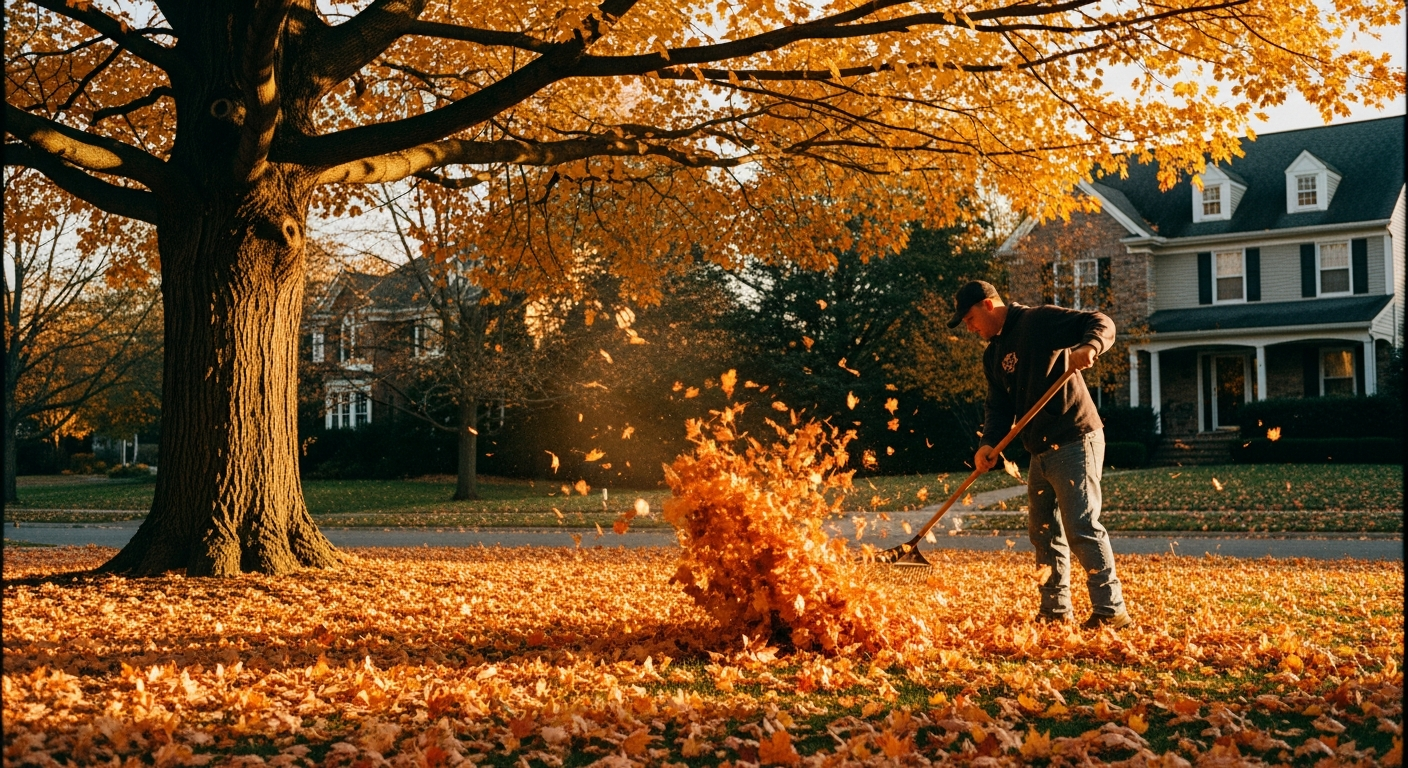
The short answer
Most yards in our service area only need two leaf cleanups, not five. Run the first pass when the canopy is roughly 60% bare — usually mid-to-late October — and the second after the trees are completely empty, in early November. Two well-timed passes collect more than 95% of seasonal volume in a fraction of the time of weekly raking.
Key stats
- A thick mat of unraked leaves can smother a cool-season lawn in as little as 10 days, increasing snow mold risk by spring.Source: University of Wisconsin-Madison Division of Extension
- Mulched leaves can return up to 80% of the nitrogen, phosphorus, and potassium they contain back to the soil — but only when shredded thin.Source: Michigan State University Extension
- Yard waste makes up roughly 12% of the U.S. municipal waste stream every fall, with leaves the largest contributor.Source: U.S. Environmental Protection Agency
You do not need to rake every weekend. You need to rake the right two weekends.
After watching customers wear themselves out on a five-pass schedule, we settled on a two-pass cleanup that works for almost every yard in our service area. The trick is timing.
Why two passes instead of weekly raking?
Trees drop leaves on a curve, not evenly. The first three weeks produce maybe 15% of the season's volume, the middle two weeks produce 70%, and the last week produces the rest. Raking on a weekly cadence means doing five passes that each collect almost nothing. Time the cleanups to the curve and you do the same work in two visits.
Pass one: when 60% of leaves are down
Wait. Most homeowners start raking the day the first leaves drop. That is wasted effort. The trees are not done. Wait until the canopy is roughly 60% bare — usually mid to late October here.
In pass one we:
- Mow the lawn one final time at 2.5 inches with the bag on, which mulches and collects in one pass
- Hand-rake the bed lines and around the foundation
- Tarp-haul everything to the curb or to our truck
This single pass collects roughly 70% of the season's volume. The lawn breathes again, the beds look intentional, and you have not touched the yard for six weeks.
Pass two: after the last leaf falls
The second pass happens after the trees are bare — first or second week of November in most years. This one is shorter. We:
- Blow out beds, foundation strips, and gutters
- Edge the lawn one final time before winter
- Pick up storm debris and acorns
That is it. No third pass. No "touch up" raking in December.
Can I just leave the leaves to "feed the soil"?
Mulching a thin layer with the mower is great for the lawn. A thick mat is not. If the leaves are deep enough that you cannot see the grass, they will smother the crowns and create a haven for snow mold. Mulching only works on the first light dusting, before the maples really let go.
Bagging vs. hauling — which is cheaper?
The metro yard waste program takes paper bags weekly through November. If you have fewer than ten bags, that is the cheapest option. Beyond ten bags, the cost and time of bagging exceeds what you would pay us to roll up with a tarp truck and take the whole pile in one trip.
Two passes. That is the whole guide. Add it to the calendar and stop spending fall Saturdays in the yard.
Frequently Asked
Questions homeowners actually ask us
- When should I do the first leaf cleanup of the season?
- Wait until the canopy is roughly 60% bare. In our metro area that lands between October 15 and October 28 most years. Raking the day the first leaves fall is wasted effort because more than half the season's volume is still on the trees.
- Is it really okay to mulch leaves into the lawn instead of bagging?
- Only if the layer is light enough that you can still see the grass. A single mower pass with a mulching blade chops thin coverage into nutrient-rich confetti. A thick mat will smother the crowns and create snow mold by March.
- How many bags of leaves does a typical suburban yard produce?
- In our service area, a quarter-acre lot with two mature deciduous trees produces 18 to 30 paper yard-waste bags across the fall. A single tarp-haul pickup truck holds the equivalent of about 40 to 50 bags.
- Bag pickup or junk-haul service — which is cheaper?
- For under 10 bags, the metro yard waste program is cheaper. Above 10 bags, the time and material cost of bagging exceeds what you would pay for a single haul-away visit. We charge a flat fee per truck volume and load it ourselves.
- What happens if I just leave the leaves alone all winter?
- Cool-season lawns suffer. Matted leaves trap moisture against the crowns, encouraging snow mold and pink mold. By April you will have bare patches roughly the size and shape of every leaf pile you ignored.
- Should I cleanup leaves out of garden beds too?
- Lightly, not bare. A 2–3 inch leaf layer in beds is excellent winter mulch and overwintering habitat for beneficial insects. Just clear leaves off the crowns of perennials and away from the base of shrubs to prevent rot.
- Do gutters really need to be done at the same time?
- Yes. Most leaf-related interior water damage starts with clogged gutters in November, not from snow or ice. We include gutters in our second-pass cleanup at no extra charge for single-story homes.
Sources & references
- Fall leaves and your lawn — University of Wisconsin-Madison Division of Extension
- Don't rake fall leaves — mulch them — Michigan State University Extension
- Yard trimmings material-specific data — U.S. Environmental Protection Agency

Get Your Weekend Back.
Stop staring at the overgrown lawn and the cluttered garage. One call, and it's handled.